Knowledge · 5 min read
Installing light figures: anchoring, ballast, wind, vandalism
Updated: 23 November 2026
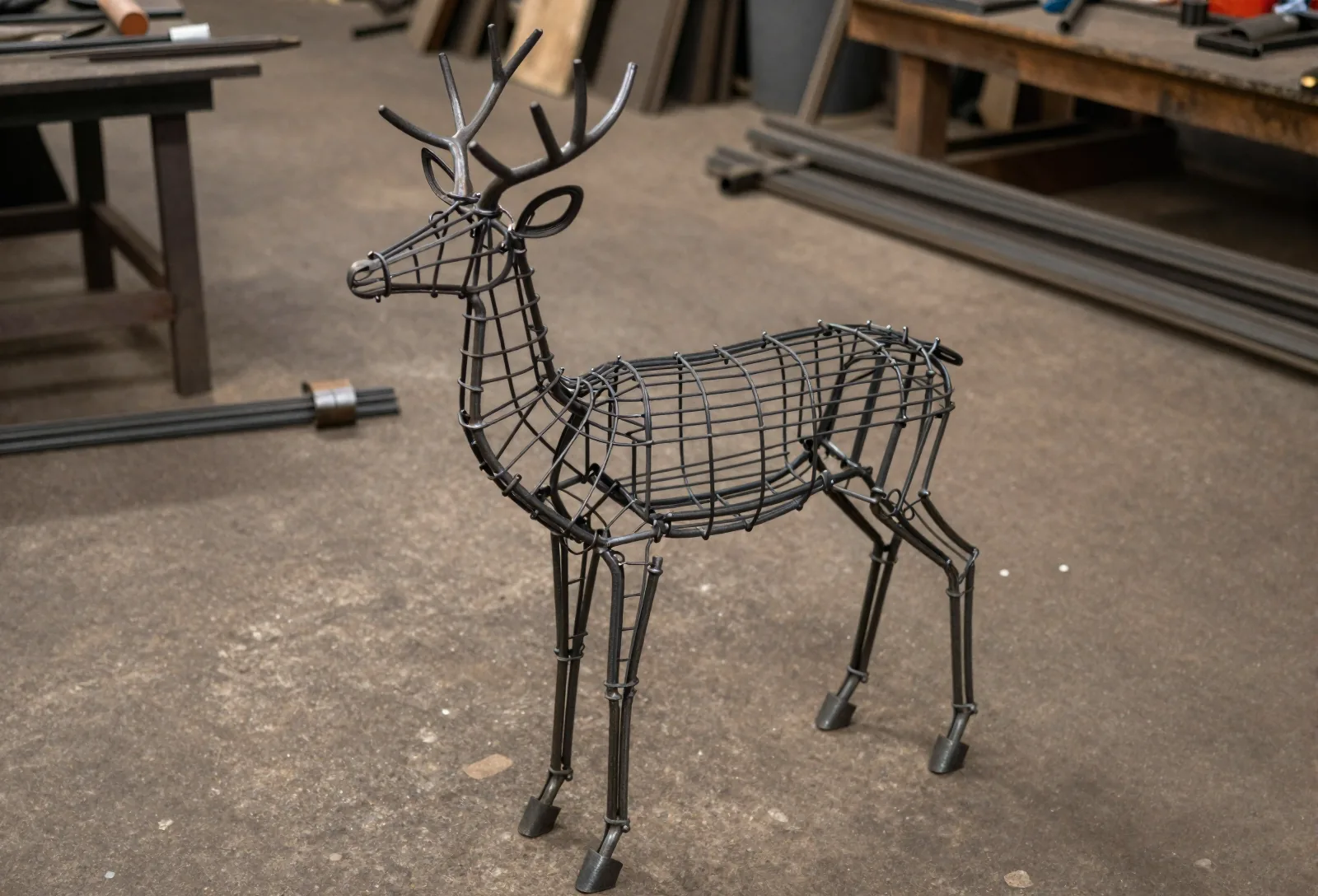
A light figure is installed in one of three ways: with anchors in an existing surface, on a steel plate with ballast made of concrete blocks, or on a foundation. The choice depends on the ground and on the wind loading, and whether the solution is safe is decided by the structural engineer's calculation, not by how the fixing looks. Vandal resistance is designed in parallel: bolts, connector covers, the height of the LED points and the lighting of the site.
Three ways to found a figure
Before anyone starts drawing the silhouette, you need to know what the figure will stand on. The ground dictates the solution, not the other way round.
| Method | When it makes sense | Main limitation |
|---|---|---|
| Anchors in an existing surface | Concrete, paving setts on a stable sub-base, paving slabs on a solid layer | Load-bearing capacity of the ground and distance of the anchors from the edge; anchoring in a thin surface without a sub-base is not permitted |
| Steel plate with ballast | Places where the surface must not be disturbed: town squares, plazas, lawns, roofs | Mass of the ballast and space for the blocks, which have to be concealed or secured |
| Foundation | Permanent, year-round installations, tall silhouettes | Groundworks, permits, time; difficult to dismantle |
Anchoring leaves the smallest footprint in the space and usually gives the best resistance to overturning, but it requires checking what lies beneath the paving or setts. A ballasted plate lets you leave the surface untouched and is predictable to install. A foundation is reserved for projects that are meant to stand for many seasons.
Ballast and guy lines: what goes into specifications
Tender documents for illuminations regularly contain provisions on ballast and guy lines, and on a technical design confirmed by a qualified structural engineer (platformazakupowa.pl, sample specification). Public contracting authorities increasingly require documented stability rather than a mere assurance that "the structure is stable".
Ballast only makes sense if it is calculated and permanently connected to the plate. Loose blocks lying next to the base are not ballast, they are decoration: the first stronger gust will shift the silhouette together with the plate or topple it. The blocks should be bolted down or locked into the frame of the plate, and their arrangement chosen so that the centre of gravity of the whole assembly sits as low as possible and as close as possible to the axis of the silhouette.
Guy lines (cables, tie rods) are used on tall, slender figures, but only where there is room to anchor them and where they do not endanger passers-by. A guy line on a busy square is a trip hazard waiting for its victim; if it is unavoidable, it is marked and protected.
Wind: a large silhouette is a sail
An advertising or decorative figure usually has a large projected area and a low self-weight. A flat, solid silhouette of a reindeer, a star or lettering behaves in the wind like a sail: the force of pressure grows with the area, and the overturning moment with the height at which that force is applied. That is why two figures of similar mass can have completely different foundation requirements.
What affects wind loading:
- the area and height of the silhouette and its shape (solid, open-work, with openings),
- location: an open square and the corner of a building are entirely different conditions from a sheltered courtyard,
- the height of the foundation (roof, platform, lawn),
- the method of connection to the ground and the rigidity of the supporting structure.
The calculations are done by the structural engineer: they select the design loads, check overturning, sliding and the capacity of the anchors or connections, and then approve the number and placement of the fixings or the mass of the ballast. The contractor should not replace this with "experience from the previous figure". An open-work structure of tubes and profiles, in which the light forms an outline instead of a solid surface, also has a real advantage here: it lets part of the airflow through.
A practical tip: in your request for quotation, state the location and the type of ground. Without these two pieces of information nobody can reliably calculate the ballast or the anchors, and an offer without them is an offer made "by eye".
Power supply and electrical safety
The figure's power supply should operate in a sealed enclosure, in a place inaccessible to casual passers-by and protected from water. Cables are routed in conduits so that they do not lie loose on the ground or protrude from under the plate. External connectors must be adequately sealed, and their height above the ground chosen so that they do not stand in a puddle.
The whole circuit is protected by a residual current device. Connection to the supply installation is carried out by a qualified electrician; this is not a task for the structure installers or for the client's staff. It is also worth agreeing in advance who is responsible for the power supply point and its labelling, because on outdoor projects it is precisely the lack of clearly assigned responsibility that usually causes delays.
Vandalism: design for it from the start
Installations in public space are targets for attacks and attempted theft, and the costs can be measurable. An example from Wrocław: after an attack on the Christmas tree in the town square, the repair was priced at 1 800 zł (wroclaw.pl). This shows that even a single instance of damage is a concrete expense, and to it are added the days when the decoration does not fulfil its purpose.
It is worth planning protection on several levels:
- Fixing elements: anti-theft bolts or bolts secured against loosening with a standard key, welded or capped nuts in places accessible from the ground.
- Connectors and cables: connector covers, cable routing inside profiles, no exposed terminals.
- Height of the LED points: diodes and modules that are easy to reach from ground level are the first to be damaged or torn out; place delicate elements higher up or protect them with a polycarbonate cover.
- Surroundings: good lighting of the site and, where possible, CCTV coverage; a figure standing in a dark alley without a camera is an easy target for attack.
A figure for sitting on and for photos
If the silhouette is meant to serve as a bench, a swing, a photo backdrop or a place children climb on, the design assumption changes. People load the structure at points, dynamically and in unpredictable places, not in the way a wind calculation assumes. Elements that someone might sit on or climb onto need to be reinforced, the frame stiffened, and the ballast mass or the number of anchors increased.
In such a figure the wiring is routed out of reach of hands, and edges and corners are rounded. It is better to state in the specification from the outset that the figure is "for use" than to add supports a week later when it turns out that people do sit on it after all. Before cutting any steel, the workshop in Gryfice prepares a 3D model for approval, documents every stage with photographs, and delivers a quote within 48 h.
Frequently asked questions
Can a large light figure stand on concrete blocks alone?
Only if the blocks are part of a calculated system: connected to the steel plate and sized for the wind loading by a structural engineer. Loose blocks next to the base do not provide stability.
Who connects the figure to the power supply?
A qualified electrician. The circuit should have residual current protection, and the power supply should operate in a sealed enclosure with protected cables.
How can the risk of vandalism be reduced?
Anti-theft bolts, connector covers, LED points placed out of reach from the ground, and good lighting and CCTV at the site. It is best to account for this at the design stage, not after the first damage.
Sources: wroclaw.pl; platformazakupowa.pl.

Custom 3D Light Figures: A Guide for Towns and Businesses
What 3D light figures are, the types available, what drives the price and how ordering works: a guide for municipalities, galleries, parks and hotels.
Silhouette 3D or 3D light figure? Choosing the right type
Silhouette 3D or 3D light figure? A comparison of construction, weight, transport and installation site, with guidance on choosing the right type of.
IP44, IP65, IP67: which LED lighting lasts an outdoor season
What IP44, IP65, IP67 and IK06 mean for outdoor LED lighting, and how to choose connector sealing, cable and voltage for seasonal installations.