Knowledge · 5 min read
Servicing and storing light figures for many seasons
Updated: 23 November 2026
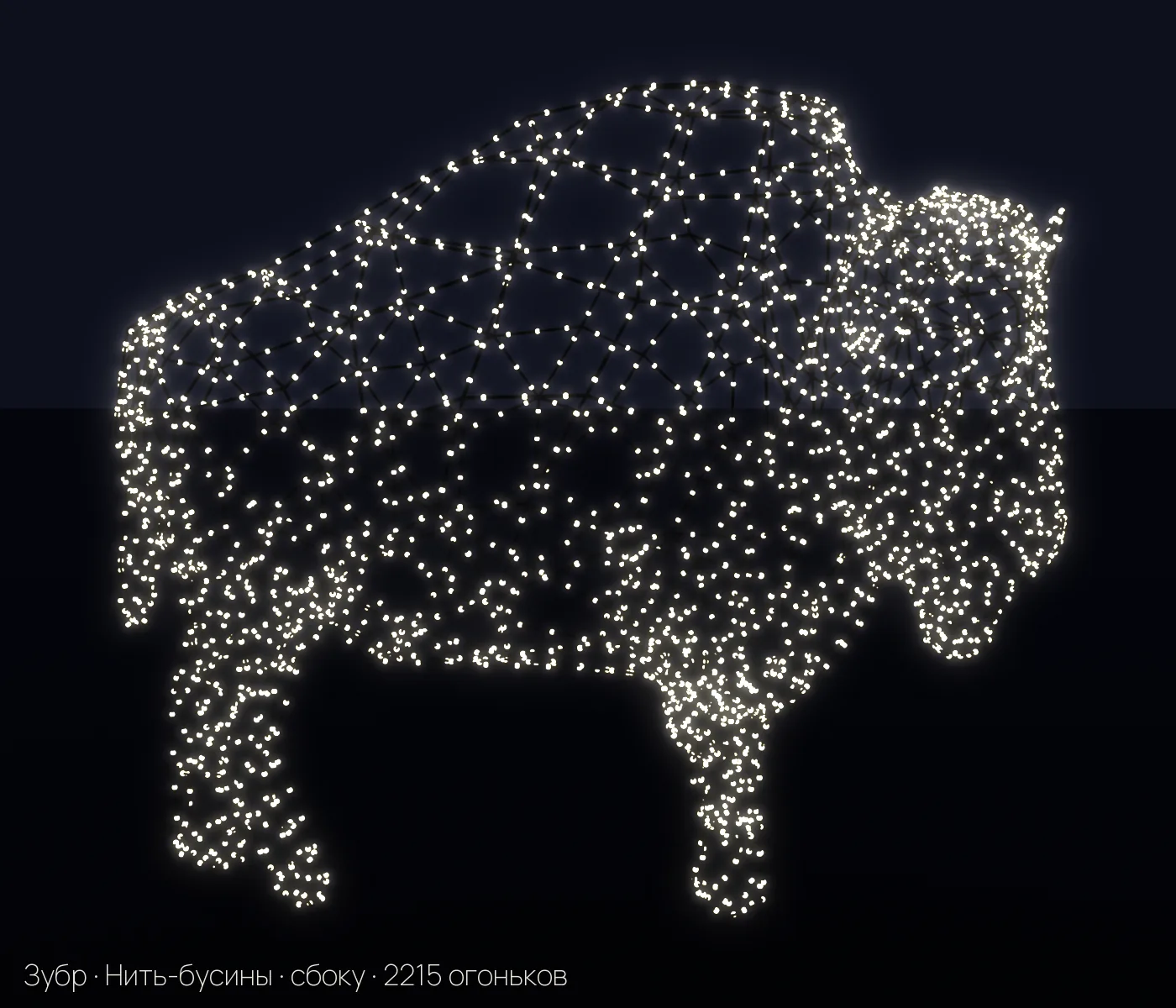
A light figure will last several seasons if each year it goes through three stages: testing every circuit before installation, replacing a faulty module rather than repairing it in the frost, and drying, labelling and packing it into dry storage after the season. Most failures stem from neglect: moisture in the connectors, cable poorly fastened to the rod and string lights bundled into a tangle.
Why servicing determines how a figure looks
A good figure is a steel frame, rods, LED string lights mounted on them, and power supplies and connectors inside. Even when well made, each of these elements works in harsh conditions: moisture, frost, wind, vibration and temperature swings. The consequences are then visible on the street. Residents of Goleniów described in a local news site parts of the illuminations with torn-off string lights and “cold” light. These are two classic symptoms of a missed inspection: the cable fastening gave way, and some of the LEDs or power supplies were replaced with a different type without care for colour temperature.
Servicing is therefore not an add-on but part of operation. A figure that nobody checked before the season is more likely to go dark in mid-December, when access to it is hardest.
Pre-season check
We carry out the check in a hall or garage, before the figure goes to its location. Repairing a finished figure on a pole or a roof takes many times longer than finding the fault on a bench.
- Test each circuit separately. We connect each circuit in turn and view it with the room lights off. We look for LEDs that do not light, flicker or differ in colour from the rest.
- Connectors and end caps. We check that plugs seat fully, that the seals are neither flattened nor cracked, and that the free ends of the string lights have end caps fitted. A connector from last season that looks dull or shows signs of corrosion is replaced without discussion.
- Cable fastenings to the rod. Cable ties and clips age from UV and frost. The cable must not hang under its own weight or rub against a sharp edge. It is precisely failing fastenings that lead to “torn-off string lights” on a finished figure.
- Power supplies and supply cables. We inspect the insulation and look for cracks where cables enter the enclosures and for traces of water inside.
Steel frame: paintwork and weld seams
The frame is meant to outlast the electronics by many seasons, so it deserves a separate inspection. We start by examining the weld seams: we look for cracks, especially at corners and at the base, where wind load is greatest. A cracked weld seam will not “wait until next year” — it needs repairing by a welder, not a makeshift coat of paint.
Next we check the coating. Chips, scuffs from transport and small spots of corrosion are repaired straight away: we clean back to bare steel, apply primer and a topcoat matching the factory coating. Rust under paint keeps spreading and is clearly visible after a single season. It is also worth checking the mounting bolts and anchors, and whether the base has been bent during last year's dismantling.
Why modular circuits make servicing easier
A figure can be built from one long string of lights covering the whole form, or from shorter sections, each with its own connector. The first approach is cheaper to produce, the second far more convenient to service. When a figure is divided into modules, a fault affects one short section rather than the whole.
- A faulty module is replaced in a few minutes, without taking the whole figure apart.
- Diagnosis is simple: one circuit goes out, so you know where to look.
- A stock of spare modules, rather than whole string lights, takes up little space and allows an immediate response.
- A new module can be matched to the colour of the others, which limits the “cold” patch effect in a warm-toned figure.
Tip: when ordering a figure, ask for a full set of spare modules from the same batch. LEDs from different production runs can differ in colour even when the colour name is the same.
In-season servicing: replace, don't repair
Once the figure is in place, the rule is simple: we don't repair in the frost, we replace. Soldering, gluing and insulating a connector in the rain or at sub-zero temperatures usually gives a result that lasts a few days. Swapping the whole module for a spare is quick and durable, and the damaged section goes back to the workshop and returns to the spare pool after being repaired in normal conditions.
For this to work, you need three things prepared: spare modules, a description of the circuits on the figure and in the documentation, and a person who knows where the right connector is. It is also worth making one visual check during the season after strong wind or a sudden change in the weather, because that is when the fastenings work hardest.
After the season: drying, coiling, storage
The way a figure is taken down and packed away determines the condition in which you will see it a year later.
- Drying. Before you pack anything, everything must be dry. Trapped moisture in connectors and under wrapping is a straight path to contact corrosion and mould on the insulation.
- Coiling string lights. We coil string lights loosely, on a spool or a large reel, without sharp bends and without knots. A tangle in a sack is the most common cause of cracked cables and torn-out LEDs.
- Labelling circuits. Every module and every circuit is permanently marked: number, position on the figure, colour. This makes installation next year quick and removes the guesswork over what connects where.
- Dry storage. Store the electronics in a dry, ventilated room, away from chemicals and sources of moisture. The frame is supported so that it does not sit in a puddle or rest thin elements on the floor.
- Protection from rodents. Rodents readily gnaw cable insulation. Closed crates or containers, no food scraps in the store and periodic checks reduce the risk. A cable gnawed over winter only comes to light when tested in the next season.
Service checklist
| Stage | What to check | Response to a fault |
|---|---|---|
| Before the season | Every circuit, LED colour, connectors, end caps, cable fastenings to the rod | Replace the module or connector, replace cable ties |
| Before the season | Weld seams, paint coating, bolts and anchors | Repair the weld seam, treat corrosion spots |
| In season | Check after wind, stock of modules, circuit labelling | Replace the module, repair in the workshop |
| After the season | Drying, loose coiling, labelling circuits | Dry again, repack |
| Storage | Dry room, protection from rodents | Change location, closed containers |
If you are planning a figure that is meant to serve for several seasons, it is worth allowing at the design stage for division into modules and access to the connectors. In our workshop in Gryfice we produce a 3D model for approval before cutting, send photos from every stage, and prepare the quote within 48 hours.
Frequently asked questions
When is the best time to inspect figures before the season?
Well in advance, before installation work begins, so that there is time to order spare modules or connectors. A check on a bench in the hall is faster and cheaper than fixing faults on an installed figure.
In season, is it better to repair a damaged string of lights or replace the module?
Replace the module. A repair in frost or rain is rarely durable, and swapping a ready-made section takes a few minutes. We repair the damaged string of lights later in the workshop and put it into the spare pool.
How do I protect string lights and cabling from rodents in storage?
Keep them in closed, sealed containers in a dry room, with no food scraps nearby. Before the next season, inspect the cable insulation, because winter damage is often invisible until the first test.
Sources: wgoleniowie.pl

Custom 3D Light Figures: A Guide for Towns and Businesses
What 3D light figures are, the types available, what drives the price and how ordering works: a guide for municipalities, galleries, parks and hotels.
Silhouette 3D or 3D light figure? Choosing the right type
Silhouette 3D or 3D light figure? A comparison of construction, weight, transport and installation site, with guidance on choosing the right type of.
IP44, IP65, IP67: which LED lighting lasts an outdoor season
What IP44, IP65, IP67 and IK06 mean for outdoor LED lighting, and how to choose connector sealing, cable and voltage for seasonal installations.