Knowledge · 4 min read
Silhouette 3D or 3D light figure? Choosing the right type
Updated: 23 November 2026
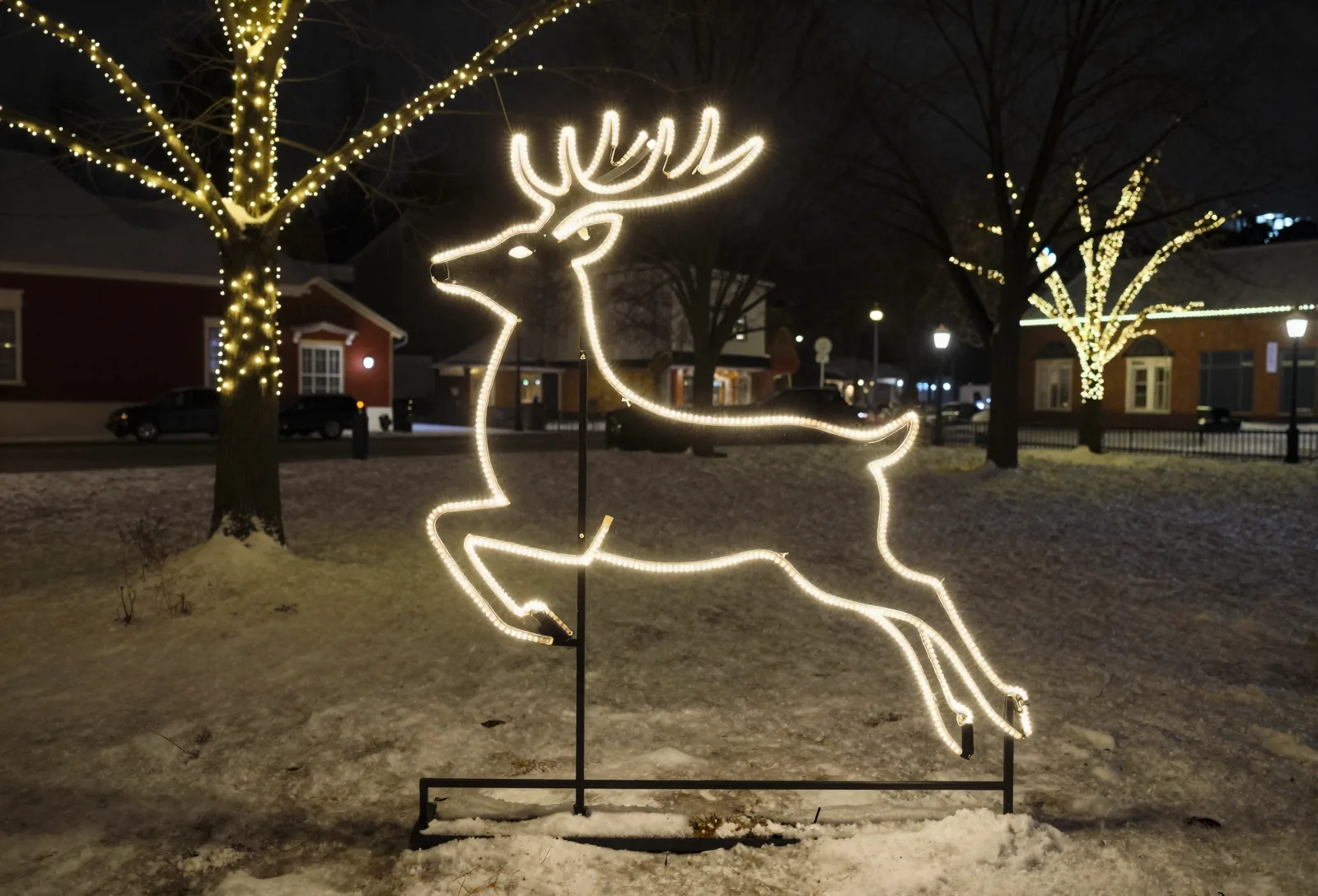
The choice comes down to where people will view the figure from. A Silhouette 3D (two flat frames joined by spacers) works well against a wall, in narrow spaces and against greenery, where it is seen from the front and at an angle. A 3D light figure (a lattice of rods) is the right choice where people walk all the way around it, for example in the middle of a town square.
Silhouette 3D: two frames and a fill
A Silhouette 3D consists of two flat steel rod frames of identical shape, set parallel to one another and joined by spacers. The outline of each frame is traced with LED rope light or neon flex. The space between the frames is filled with string lights, so that the form looks full from the side and from a three-quarter view.
The advantages follow directly from the construction:
- lower weight than a spatial lattice, simply because there is less steel,
- easier and cheaper transport: the frames are flat and can be stacked one on top of the other,
- less depth, so the figure fits against a wall, in a planted strip or in a narrow passage.
The limitation is geometric. Viewed from directly side-on, parallel to the planes of the frames, the form "collapses" and loses its depth. The wider the viewing angle, the more the flatness of the construction shows.
3D light figure: a cage of rods
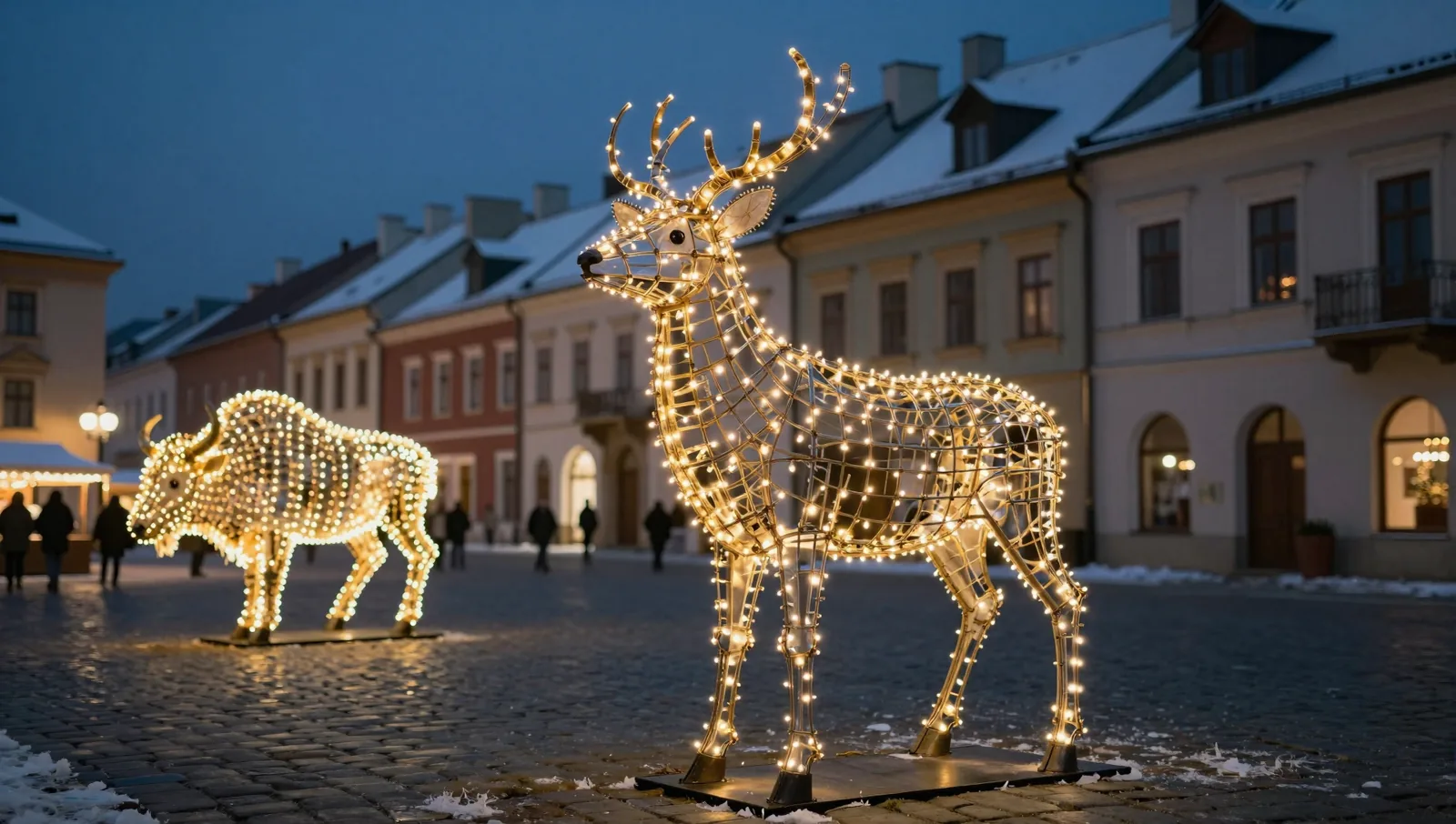
A 3D light figure is built like a lattice or cage. Hoops set perpendicular to the axis of each body part (torso, arm, leg, head) are joined by longitudinal rods running along those parts. The string lights are run along the rods, so the light is distributed throughout the whole volume rather than just across two planes.
The result: the figure looks good from every side, because there is no "flat" view from any direction. This is the better choice for the middle of a town square, a roundabout or a small public green, where passers-by circle around it and view it from different sides.
The price is weight and bulk. The cage contains more steel, more weld seams and more elements requiring anti-corrosion protection, and it takes up more space in transport because it cannot be flattened so easily. The greater mass also affects how it is founded and anchored, which has to be calculated structurally for the specific location and wind loads.
Comparison: Silhouette 3D versus 3D light figure
| Criterion | Silhouette 3D | 3D light figure |
|---|---|---|
| View from the front and at three-quarter angle | Full, form clearly readable | Full, form clearly readable |
| View directly from the side and from behind | Weaker, flatness of the frames visible | Full from every side |
| Weight | Lower | Higher |
| Transport | Simpler, flat frames | Bulkier |
| Placement | Against a wall, in narrow spaces, against greenery | In the middle of a square, wherever people walk all the way round the figure |
| Installation | Fewer elements to position | Heavier, requires more substantial foundations |
A third option: the faceted stainless steel sculpture
If you want the figure to look good during the day as well, consider a faceted stainless steel sculpture. It is made up of flat, angled planes that reflect daylight and create a striking form without any lighting switched on. After dark it can be illuminated.
This follows a different logic from the constructions designed for string lights. The Silhouette 3D and the 3D light figure come to life mainly after dark, and by day they are a skeleton of rods. The faceted sculpture works around the clock, which matters where the figure stands in plain view outside the festive season too.
How to choose in practice
A simple list of questions helps with the decision:
- From how many sides will people see the figure? If only from one or two (a wall, the edge of a public green), a Silhouette 3D is enough.
- Can people walk freely around the figure? If so, that favours a 3D light figure.
- How much space is there for depth? In a narrow strip or a tight passage, the silhouette fits more easily.
- How will the figure reach the site and who will install it? Weight and bulk translate into transport and installation equipment.
- Does the figure need to be visible during the day? In that case, it is worth comparing it with a faceted sculpture.
Start with a photograph of the site and estimate the distance from which people will be looking. From a greater distance and at an angle, the differences between the types of construction are less visible. Up close, and with people walking all the way round, the flatness of the silhouette starts to become noticeable.
If you already have photographs of the location, at our workshop in Gryfice we prepare a 3D model for your approval before cutting, document every stage with photographs, and send the quote within 48 hours.
Frequently asked questions
Is a Silhouette 3D inferior to a 3D light figure?
No, they are different tools for different places. A Silhouette 3D gives a full appearance from the front and at an angle, with lower weight and simpler transport. A 3D light figure wins only where it is seen from all around.
Do the string lights inside the silhouette really create the effect of a full form?
Yes, when viewed from the front and from a three-quarter angle. The string lights fill the space between the two frames, so the outline does not look like an empty skeleton. Viewed from directly side-on, the effect weakens.
When is it worth choosing a faceted stainless steel sculpture?
When the figure needs to be attractive during the day as well, not only after dark. The light-reflecting planes create a striking form without any lighting switched on, and in the evening it can be illuminated.
Sources: this article draws on the author's structural expertise; there are no external numerical sources.
Custom 3D Light Figures: A Guide for Towns and Businesses
What 3D light figures are, the types available, what drives the price and how ordering works: a guide for municipalities, galleries, parks and hotels.
IP44, IP65, IP67: which LED lighting lasts an outdoor season
What IP44, IP65, IP67 and IK06 mean for outdoor LED lighting, and how to choose connector sealing, cable and voltage for seasonal installations.
String lights, LED rope or neon flex: lighting a light figure
String lights, LED rope light or neon flex? How to light a light figure: outline, infill, 3D form and steel sculpture. A practical selection guide.