Knowledge · 5 min read
How municipalities buy light decorations: PLN 170,000 threshold
Updated: 23 November 2026
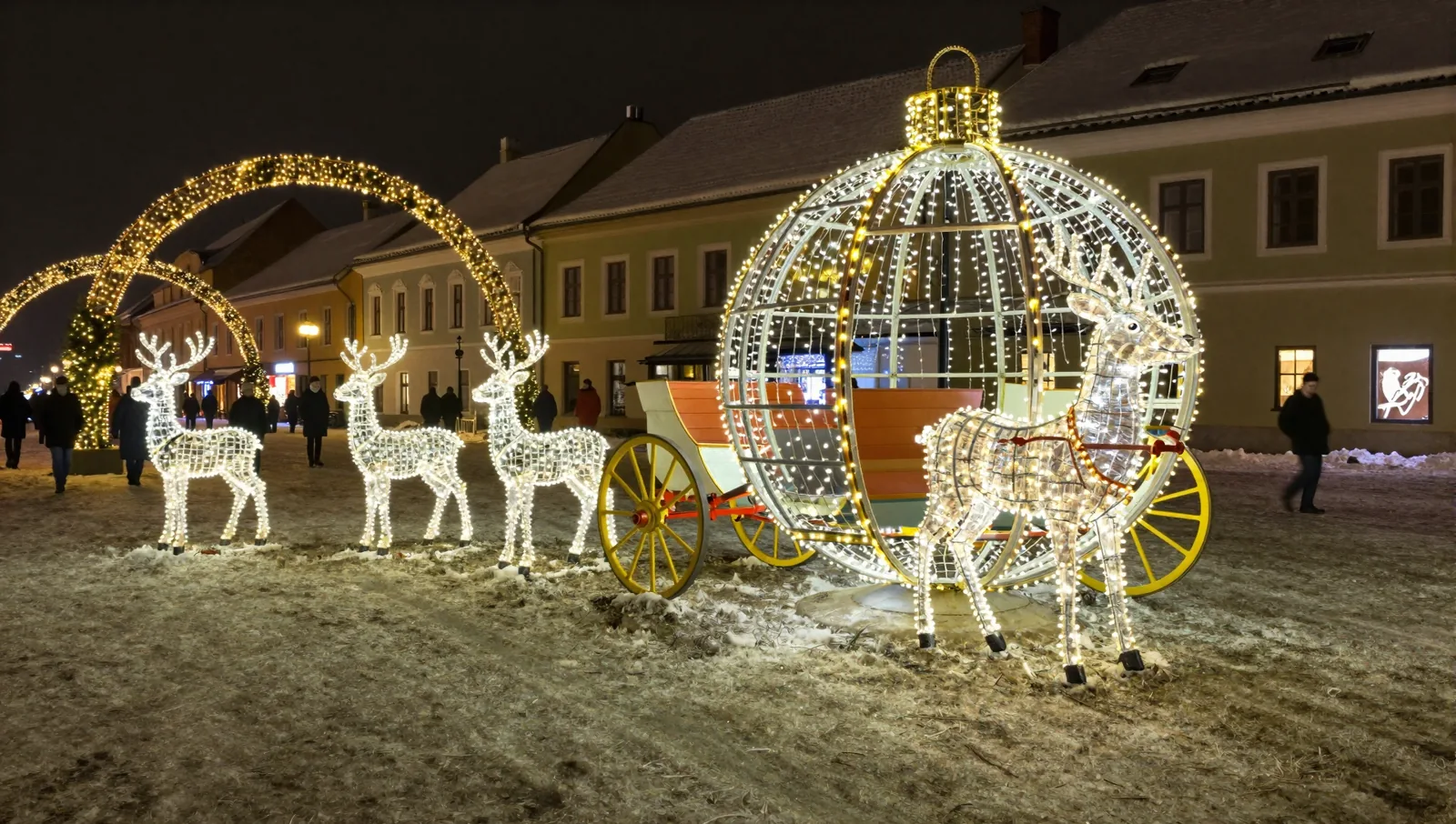
A municipality buys light decorations under the Polish Public Procurement Law if the contract value exceeds PLN 170,000 net (the threshold in force since 1 January 2026 for classic contracts); below that amount it applies the unit's internal regulations. In both cases the quality of delivery depends above all on the description of the subject matter of the contract: dimensions, number of LEDs, voltage, IP, IK, anchoring, warranty and scope of installation.
The PLN 170,000 threshold: what it changes for the contracting authority
Since 1 January 2026, the threshold for applying the Polish Public Procurement Law to classic contracts has been PLN 170,000 net. The value is estimated net, and with light decorations it is easy to get this wrong, because the contract value must include everything the contracting authority actually buys in a single undertaking: decorations, anchors or ballast, installation, dismantling and storage. Splitting a purchase into parts solely to fall below the threshold is not permitted.
- Below the threshold: the contract is carried out under the unit's internal regulations. The procedure is often simpler (requests for quotation, price comparison), but in practice the principles of transparency and equal treatment of contractors still apply.
- Above the threshold: the procedure set out in the Polish Public Procurement Law applies, with a notice, deadlines, legal remedies and the possibility of an appeal to the National Appeals Chamber (KIO).
For most rural and urban-rural municipalities, a set of several motifs for the town square and the main street falls below the threshold. Medium-sized and large towns almost always exceed it, especially when a single procedure covers decorations for several years.
Description of the subject matter: what to include to get comparable bids
A vague description ("LED light decorations, 50 pieces") produces bids that cannot be compared, and disputes at the acceptance stage. A good description is a list of measurable parameters. It is worth including:
- Dimensions of each type of decoration: height, width, depth and, for hanging motifs, also the permissible weight.
- The number of LED sources per piece or the minimum density per linear metre of the structure. This is the parameter that is easiest to understate in order to lower the price.
- Supply voltage (e.g. safe low voltage with the power supply outside the decoration, or mains power) and the method of connection to the municipal infrastructure.
- Power, both per unit and in total, as it affects energy costs and the load on supply circuits.
- The IP protection rating and IK mechanical impact resistance, matched to the installation site: a motif on a lighting column has different requirements from a freestanding figure in a park, where there is a risk of damage by people.
- The method of anchoring or ballasting: for freestanding structures, the required wind resistance and the method of foundation (anchors fixed to the surface, ballast, ground anchors); for hanging ones, fixing to columns or cables and the permissible loads.
- The warranty: its length, its scope (LED sources, power supplies, structure, anti-corrosion coating), response time to a report and replacement conditions.
- Installation, dismantling and storage: who does it, when, within what deadlines, with what equipment, and where and on what terms the decorations are stored between seasons.
A practical tip: attach to the description visualisations or an illustrative drawing showing dimensions and installation locations. A contractor who can see the site prices the risk more accurately, and the contracting authority is less likely to receive half-hearted bids.
Buying or leasing for several seasons
Buying gives you ownership, but together with it come the costs of annual installation, dismantling, storage and repairs, which the contracting authority must plan for or outsource. Leasing for several seasons shifts some of these obligations to the contractor, but requires a carefully drafted contract. When choosing a model, check:
- who is responsible for failures and replacement of components during the season, and within what timeframe,
- what happens to the decorations when the contract ends,
- whether, under a leasing model, the contract value is calculated for the whole period (this matters for the PLN 170,000 threshold),
- how technical acceptance is assessed at each season, and not only at the first.
Which model is cheaper depends on the number of seasons, the scope of services and the municipality's ability to store and install the decorations itself. There is no single answer; you need to calculate the cost of the whole cycle, not just the price of the decorations.
Non-price criteria: aesthetics and warranty
Price alone rewards the cheapest solutions, and for decorations that stand in the town centre for several weeks, the visual effect matters. Non-price criteria make it possible to take this into account, but they must be described so that they can be assessed objectively. An example is the procedure run by the Municipal Roads Authority in Warsaw: in the case decided by KIO judgment 1661/26 of 8.05.2026, a criterion of compliance with the style of the streets carried a weight of 30% (UZP rulings). A high weight for an aesthetic criterion attracts contractors' attention and may become the subject of an appeal, so it is worth:
- describing how the assessment will be scored (scale, number of assessors, how the scoring is justified),
- stating what the assessment is based on (visualisations, samples, a description of the concept),
- avoiding criteria that cannot be justified in writing.
A second criterion that is easy to measure is the length of the warranty. A longer warranty only makes sense if the description of the subject matter clearly defines its scope and response time; otherwise the warranty period becomes an empty promise.
The single-bid problem
With large decoration contracts, it sometimes happens that only one bid is received, and its price is close to the budget or exceeds it. Two examples from the media:
- Rzeszów (2026): the budget was PLN 1.98 million, one bid was received for PLN 2,429,137.13, and the subject was 613 decorations (torzeszow.pl).
- Polkowice: one bid for PLN 415,269.27 gross, equal to the contracting authority's budget (waszregion.pl).
A single bid does not automatically mean irregularities, but it is a signal that the conditions of the procedure may have narrowed competition. What the contracting authority can do in advance:
- Carry out market research before setting the budget and the description of the subject matter, rather than relying solely on one quote.
- Check whether the conditions for participation (experience, required references, delivery deadlines) are not tailored to a single contractor.
- Consider dividing the contract into lots if the types of decoration differ in technology, so that smaller firms can bid for part of the scope.
- Allow realistic time to prepare a bid; short deadlines for questions and for submitting bids limit the number of participants.
The workshop in Gryfice produces a 3D model for approval before cutting, documents every stage of production with photographs and prepares a quote within 48 h.
Frequently asked questions
From what amount must a municipality apply the Polish Public Procurement Law when buying decorations?
Since 1 January 2026, the threshold for classic contracts has been PLN 170,000 net. Below this value the unit applies its internal regulations; above it, the procedure under the Polish Public Procurement Law. The contract value includes the entire scope, including installation, dismantling and storage.
What technical parameters must be included in the description of the subject matter?
The minimum is dimensions, number of LEDs, voltage, power, IP protection rating, IK resistance, method of anchoring or ballasting, warranty, and the rules for installation, dismantling and storage. The more measurable the description, the easier it is to compare bids and accept the delivery.
What should be done if only one bid is received in a procedure?
The contracting authority should assess the bid for compliance with the description of the subject matter and for justification of the price, and in subsequent procedures analyse whether the conditions for participation, the deadline and the lack of division into lots restricted competition. A price equal to or higher than the budget requires a decision to increase the funds or to cancel the procedure.
Sources: torzeszow.pl; waszregion.pl; UZP rulings.

Custom 3D Light Figures: A Guide for Towns and Businesses
What 3D light figures are, the types available, what drives the price and how ordering works: a guide for municipalities, galleries, parks and hotels.
Silhouette 3D or 3D light figure? Choosing the right type
Silhouette 3D or 3D light figure? A comparison of construction, weight, transport and installation site, with guidance on choosing the right type of.

IP44, IP65, IP67: which LED lighting lasts an outdoor season
What IP44, IP65, IP67 and IK06 mean for outdoor LED lighting, and how to choose connector sealing, cable and voltage for seasonal installations.